The best alarm app for ADHD is one that turns waking up into a short, engaging task: the alarm only stops after a mission that needs your attention (math, a photo, a barcode scan, movement), there's no snooze button, it rings again a few minutes later, and it gives you a clear next step for the morning. Weky is built around exactly that, and it rings reliably in Silent, Sleep and Focus modes. Research explains why standard alarms struggle: many adults with ADHD have a later body clock, poorer sleep and a different sense of time.
For a lot of people with ADHD, the morning goes like this: three alarms, all dismissed without memory; a scramble out of the door; the quiet promise that tonight you'll go to bed on time. Then 1 a.m. arrives and the phone is still in your hand. Normal alarms and phone alarms just don't work for ADHD brains. None of that is laziness. It's a predictable pattern — and the right alarm can break it.
Key takeaways
- The ADHD body clock often runs later. Studies find delayed melatonin onset and sleep timing in many adults with ADHD.
- Sleep is often harder. A meta-analysis found adults with ADHD report poorer sleep and take longer to fall asleep.
- Time feels different. Research on time perception helps explain "just five more minutes" turning into an hour.
- Engagement beats volume. An alarm that needs a task works better than a louder one.
- Structure beats willpower — missions, no snooze, a wake-up check and a clear morning checklist.
Why mornings are harder with adult ADHD
ADHD affects executive function — starting tasks, time management, switching from one state to another. Waking up is all three at once, which is why so many ADHD adults can't wake to a standard alarm.
1. A body clock that runs later
Your circadian rhythm decides when you feel sleepy and when you feel alert. In a study published in Biological Psychiatry, adults with ADHD and sleep-onset insomnia had a delayed start and end of their sleep period and a later melatonin onset than healthy controls. A systematic review of circadian research in ADHD reached a similar picture: evening chronotypes and delayed rhythms are common. Researchers have even asked whether circadian problems should be seen as part of ADHD itself.
In practice, a 7 a.m. alarm can ring at what your body considers the middle of the night. That makes waking up — and staying up — much harder.
2. Sleep that's shorter and lighter
A systematic review and meta-analysis of sleep in adults with ADHD found they report poorer sleep quality and longer time to fall asleep. Short or broken sleep makes morning grogginess — sleep inertia — stronger and longer, and that's the state in which alarms get switched off without a memory of it.
3. Time blindness
Many people with ADHD describe "time blindness": minutes feel elastic, and "five more minutes" quietly becomes forty. A meta-analysis of time perception studies found consistent differences in how young people with ADHD estimate and reproduce time. A snooze button is the perfect trap for that.
4. Night-time procrastination
Evenings are often the only time that feels free, and endless feeds are built to hold attention. Bedtime procrastination — going to bed later than you intended for no external reason — is common in general, and many adults with ADHD say it hits them hard. More in revenge bedtime procrastination.

What features should alarm clocks for ADHD have?
The best ADHD alarm clock isn't just a loud alarm. ADHD users tend to do best with an app that turns the morning into a task and a routine — the same principle as a to-do list.
| Feature | Why it helps an ADHD brain |
|---|---|
| Wake-up missions | A task that needs attention — a math problem, or having to scan a barcode to turn the alarm off — breaks the automatic "tap and sleep" habit and helps you wake. |
| Variety | A different mission keeps it novel, so it doesn't become automatic. |
| No snooze button | Removes the time-blindness trap entirely. |
| Wake-up check | A second ring catches you if you drift back to bed. |
| Rings in any mode | Silent, Sleep, Work or any Focus — no "did I set it right?" worry. |
| Morning checklist | Makes the next step obvious, so you don't stall after getting up. |
| Visible streaks | Instant, visible progress is motivating. |
| Evening app limits | External limits on the apps that keep you up past bedtime. |
How Weky is built for ADHD mornings on iOS
We built Weky to make mornings simpler for anyone who struggles to get up — and ADHD mornings are exactly where structure helps most.
Missions that grab your attention
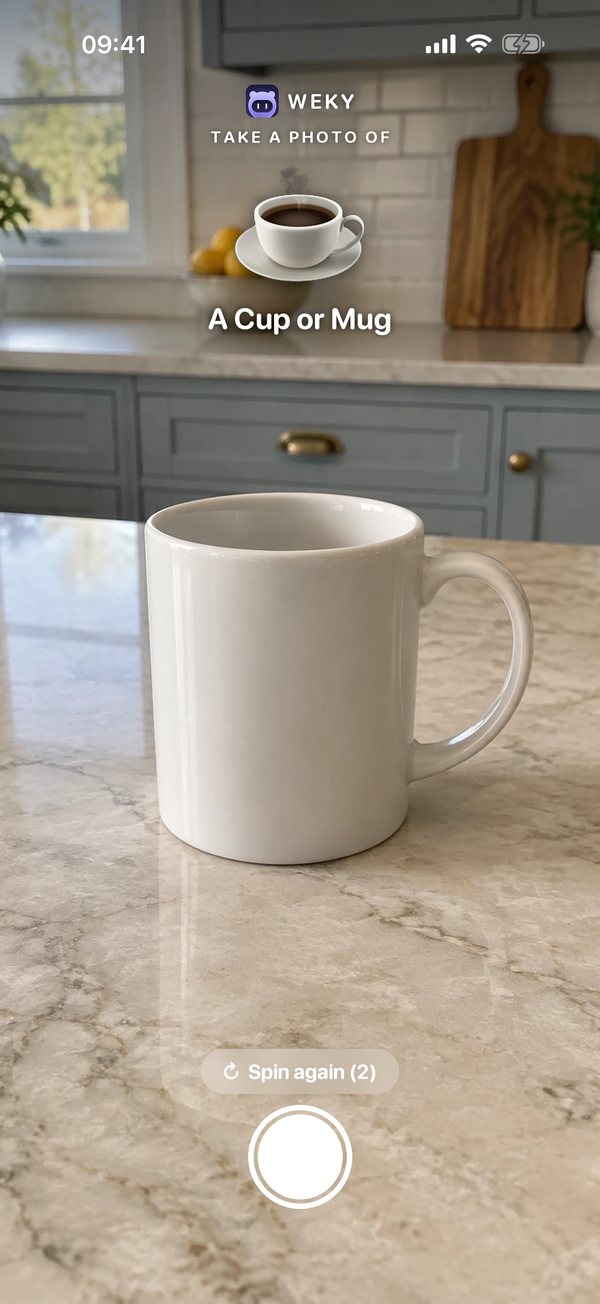
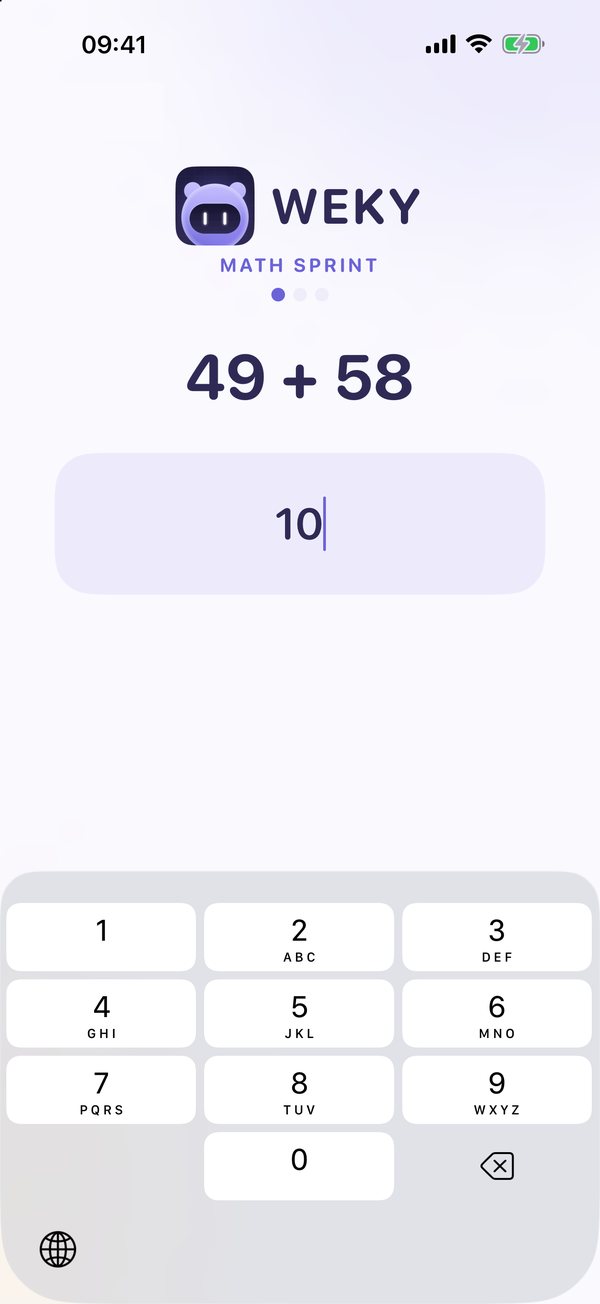
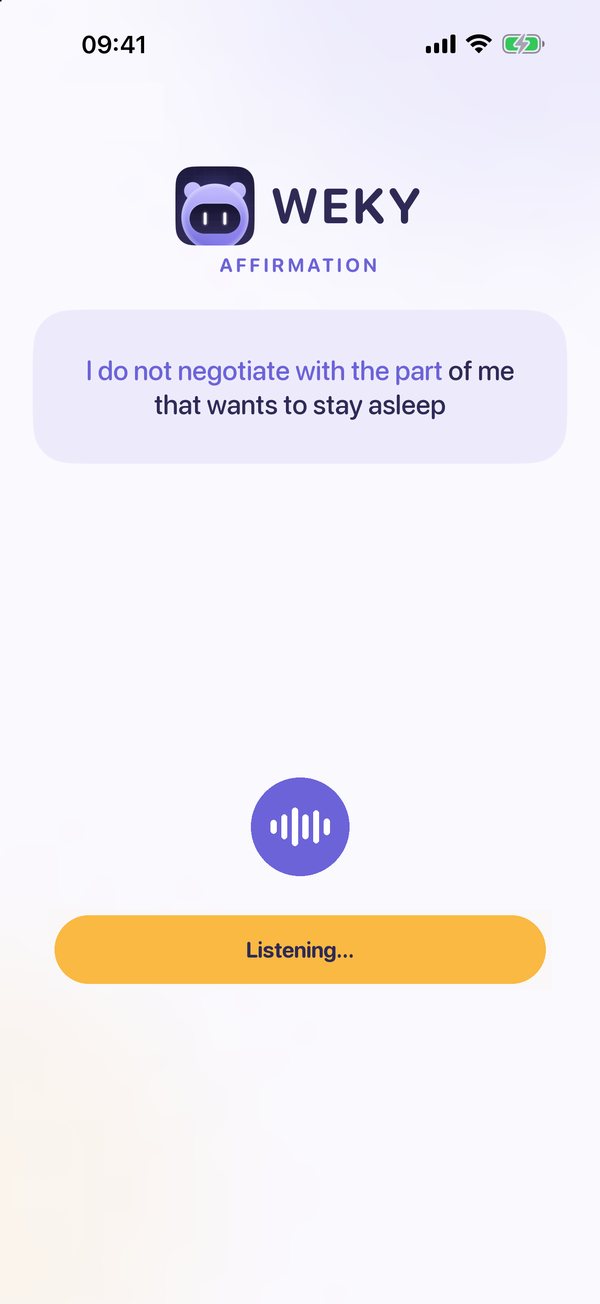
The alarm only stops after a wake-up mission. There are ten — Math Sprint, typing, push-ups and squats counted on camera, an object hunt, a photo of the sky, a photo of your made bed, a barcode scan, shaking the phone, and saying an affirmation out loud. You can stack several, and the wake-up check can use a random mission, so mornings stay fresh instead of automatic.
No snooze, and a second check
There's no snooze button anywhere. About ten minutes after you finish, the wake-up check rings again — so if time blindness pulls you back under the duvet, Weky catches it.
It rings every time
Weky schedules a real system alarm. It rings on the lock screen in Silent mode, Sleep, Work or any Focus, after a force-quit or a restart, and it doesn't need to run in the background or drain your battery. One less thing to double-check at night.
A clear first step: Start My Day
After the alarm, a short checklist — water, stretch, make your bed — so your morning routine has momentum and you actually get out of bed instead of staring at a blank screen.
Habits and streaks you can see
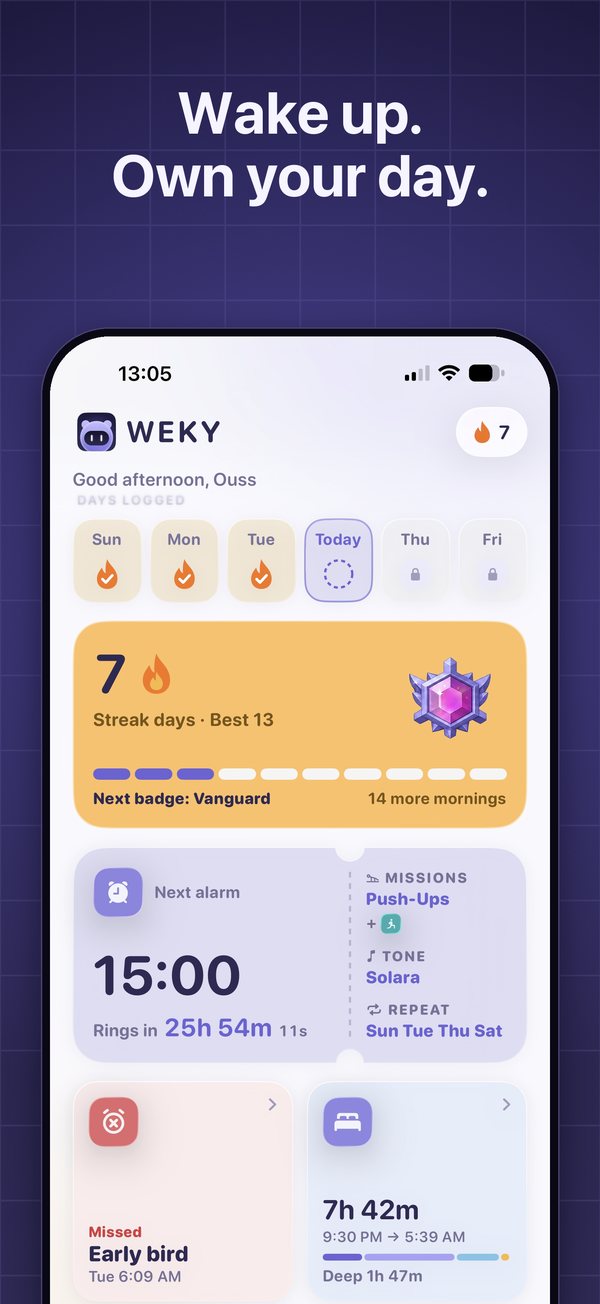
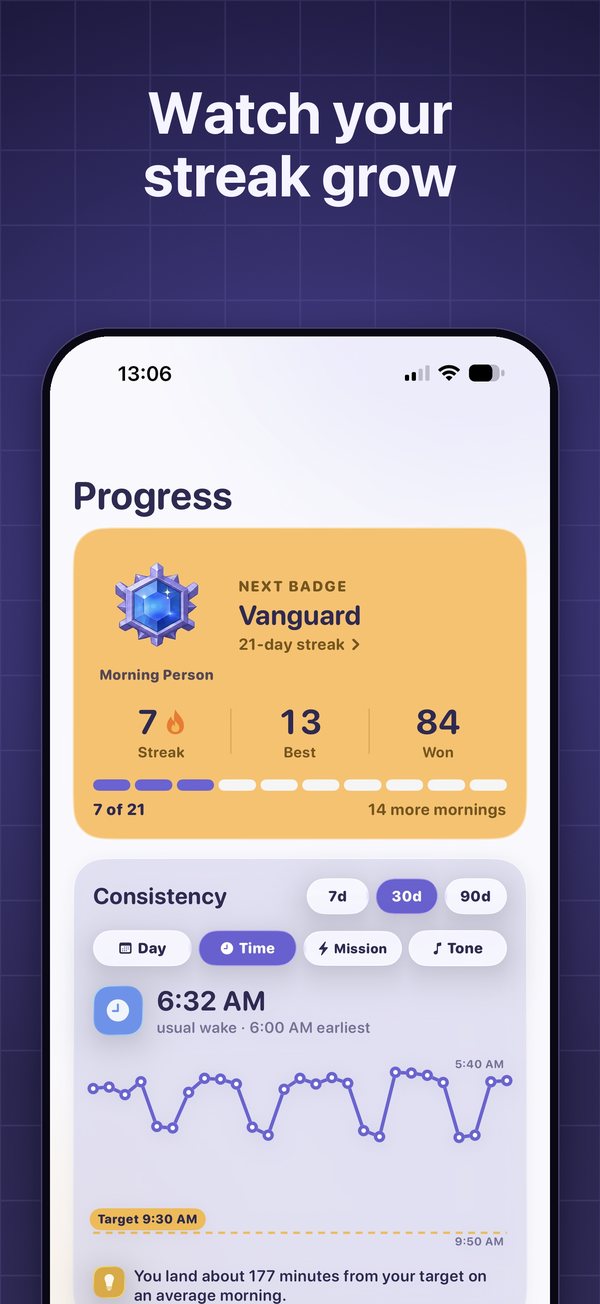
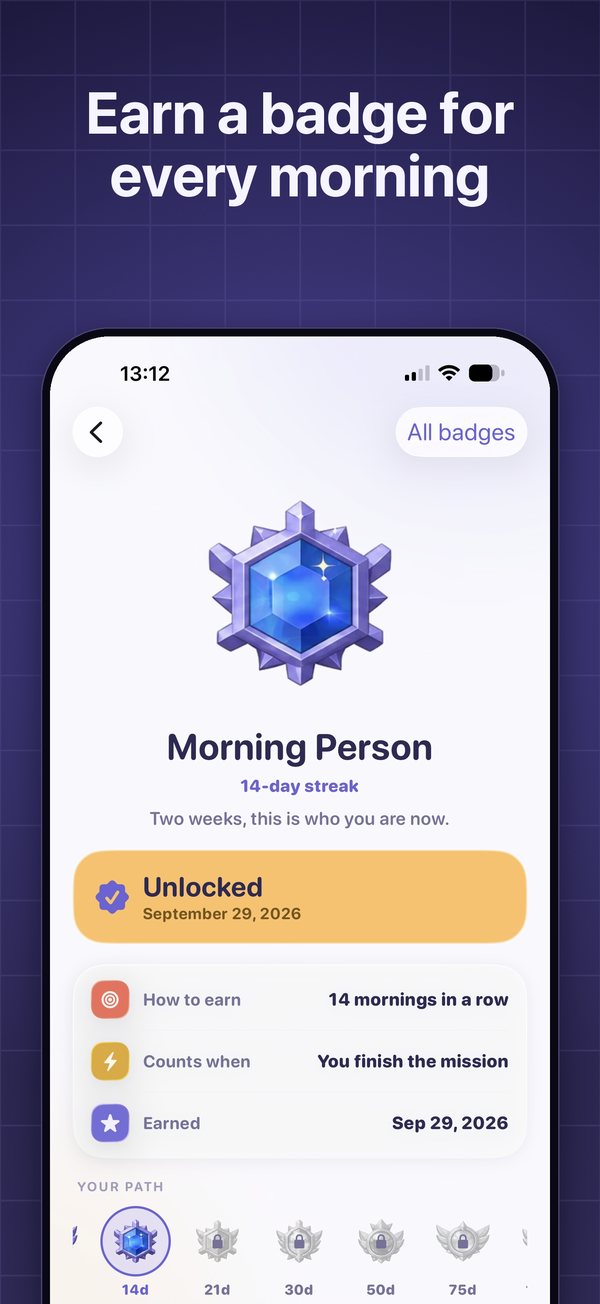
Each habit — gym, study, reading, or one you name — gets its own alarm, colour and 90-day calendar. Your streak grows with every morning you win. Morning history shows which weekday you struggle with most, so you know where to add support.
Evening limits on the apps that keep you up
Pick the apps you lose your nights to and a start time. They stay locked until your morning mission is done — structure outside your head, so bedtime doesn't depend on willpower at midnight.
Tips for waking up with ADHD
- Get morning light fast. Light is the strongest signal for moving a late body clock earlier. Open the curtains, or step outside for ten minutes.
- Set an alarm for one wake time every day. Consistency matters more than an early time. Shift it in 15-minute steps — see how to wake up early.
- Prepare the night before. Clothes out, bag packed, keys by the door. Fewer decisions in the morning.
- Put the next step where you'll see it. A checklist on your phone or a note on the door.
- Choose a clear alarm sound. Melodic tones are associated with less grogginess than harsh beeps; change it now and then.
- Make snoozing impossible. Here's how to stop hitting snooze.
- Talk to your doctor if sleep problems are persistent — sleep is a recognised part of ADHD care, and timing of light and routines can be discussed with a professional.
Other alarm options people with ADHD use
Different kinds of ADHD and different mobile apps suit different people. Some use Alarmy or other mission alarms, some use a smart alarm such as Sleep Cycle (or Sleep as Android on Android) to wake in lighter sleep; some use a reminder app like Galarm or a simple timer for daytime tasks; some keep a physical alarm clock across the room; others use a sunrise lamp for morning light. Many combine several. If you're comparing mission alarms more broadly, see the best alarm apps for heavy sleepers and the best alarm apps for iPhone.
Weky is a wake-up and habit tool, not a treatment for ADHD. This article is general information based on published research.
Frequently asked questions
What is the best alarm app for people with ADHD?
Look for an alarm that needs an engaging task to stop (math, a photo, a barcode, movement), has no snooze button, rings again a few minutes later, and helps with the first steps of the morning. Weky is built around exactly those features, on iPhone and iPad.
Why do people with ADHD struggle to wake up to standard alarms?
Research links ADHD with a delayed body clock, so early alarms land in the biological night. Many adults with ADHD also report longer time to fall asleep and poorer sleep, which makes grogginess worse. A standard alarm only needs one half-asleep tap to stop — easy to do automatically.
What features should an ADHD alarm app have?
Missions that require attention, no snooze, a second wake-up check, alarms that ring reliably in Focus and Silent modes, a simple morning checklist, habit tracking with visible streaks, and a way to limit late-night phone use.
What are the best alarm sounds for people with ADHD?
Clear, melodic tones tend to be associated with less grogginess than harsh beeps, and changing the tone every few weeks helps your brain keep noticing it. Many people with ADHD also benefit from variety — a different mission each morning keeps it from becoming automatic.
Are sunrise alarms good for ADHD?
Morning light helps shift a late body clock earlier, so a sunrise lamp or opening the curtains straight away can help. Light helps you wake; it doesn't stop you from going back to sleep, so pair it with an alarm you can't dismiss in bed.
Can an alarm app help with daily routines?
Yes. Weky lets you set separate alarms for habits like the gym, study or reading, each with its own 90-day calendar, and a Start My Day checklist after the morning alarm.
References
- Van Veen MM, Kooij JJS, Boonstra AM, Gordijn MCM, Van Someren EJW. Delayed circadian rhythm in adults with attention-deficit/hyperactivity disorder and chronic sleep-onset insomnia. Biological Psychiatry, 2010;67(11):1091–1096.
- Coogan AN, McGowan NM. A systematic review of circadian function, chronotype and chronotherapy in attention deficit hyperactivity disorder. ADHD Attention Deficit and Hyperactivity Disorders, 2017;9(3):129–147.
- Bijlenga D, Vollebregt MA, Kooij JJS, Arns M. The role of the circadian system in the etiology and pathophysiology of ADHD: time to redefine ADHD? ADHD Attention Deficit and Hyperactivity Disorders, 2019;11(1):5–19.
- Díaz-Román A, Mitchell R, Cortese S. Sleep in adults with ADHD: systematic review and meta-analysis of subjective and objective studies. Neuroscience & Biobehavioral Reviews, 2018;89:61–71.
- Zheng Q, Wang X, Chiu KY, Shum KK. Time perception deficits in children and adolescents with ADHD: a meta-analysis. Journal of Attention Disorders, 2022;26(2):267–281.
- Hilditch CJ, McHill AW. Sleep inertia: current insights. Nature and Science of Sleep, 2019;11:155–165.
- McFarlane SJ, Garcia JE, Verhagen DS, Dyer AG. Alarm tones, music and their elements: analysis of reported waking sounds to counteract sleep inertia. PLOS ONE, 2020;15(1):e0215788.
- Kroese FM, De Ridder DT, Evers C, Adriaanse MA. Bedtime procrastination: introducing a new area of procrastination. Frontiers in Psychology, 2014;5:611.