To find your bedtime, start from the time you need to wake up and count back the sleep you need, plus about 15 minutes to fall asleep. For most adults that's 7.5 to 9 hours: if your alarm is at 7 a.m., aim to be in bed around 11:15 p.m. (7.5 hours) or 9:45 p.m. (9 hours). The table below does the math for common wake-up times.
Most people pick a bedtime the other way round: they go to bed "when they're tired" and then hope the alarm time works out. It rarely does. Your wake-up time is usually fixed by work, school or a train. Your bedtime is the one thing you can move. So the honest question isn't "when do I feel like sleeping?" but "when do I need to be asleep to get enough sleep before my alarm?"
Key takeaways
- Count back from your alarm: wake-up time minus the sleep you need, minus 15 minutes to fall asleep.
- Most adults need 7 to 9 hours. Teenagers need 8 to 10.
- Sleep cycles last about 90 minutes on average, so 7.5 or 9 hours often feels better than 8.
- Regularity beats perfection: the same wake time every day does more than any perfectly calculated bedtime.
- The hard part is getting to bed, not the math. Plan the hour before it.
How much sleep do you need?
The American Academy of Sleep Medicine recommends that adults sleep 7 hours or more per night on a regular basis. The National Sleep Foundation gives these ranges by age:
| Age | Recommended sleep |
|---|---|
| Teenagers (14–17) | 8–10 hours |
| Young adults (18–25) | 7–9 hours |
| Adults (26–64) | 7–9 hours |
| Older adults (65+) | 7–8 hours |
Where you sit in that range is personal. A good test: on a week of holiday, with no alarm, how long do you sleep once the first few catch-up nights are over? That's close to your real need.
Sleep cycles: why 90 minutes (and why it's only an average)
During the night you move through repeating cycles of light sleep, deep sleep and REM sleep. One cycle lasts about 90 minutes on average, but real cycles range from roughly 70 to 120 minutes and change through the night: early cycles hold more deep sleep, later ones more REM.
Why it matters: waking up from deep sleep produces the worst grogginess, called sleep inertia. Waking near the end of a cycle, in lighter sleep, usually feels easier. That's why 7.5 hours (five cycles) can feel better than a full 8. Treat cycles as a rule of thumb, not a precise clock: total sleep still matters more than hitting a cycle boundary exactly.
Bedtime calculator: when to go to bed for your wake-up time
These bedtimes include about 15 minutes to fall asleep. Pick your wake-up time, then the column that matches the sleep you need.
| Wake up at | 9 h (6 cycles) | 7.5 h (5 cycles) | 6 h (4 cycles) |
|---|---|---|---|
| 5:00 a.m. | 7:45 p.m. | 9:15 p.m. | 10:45 p.m. |
| 5:30 a.m. | 8:15 p.m. | 9:45 p.m. | 11:15 p.m. |
| 6:00 a.m. | 8:45 p.m. | 10:15 p.m. | 11:45 p.m. |
| 6:30 a.m. | 9:15 p.m. | 10:45 p.m. | 12:15 a.m. |
| 7:00 a.m. | 9:45 p.m. | 11:15 p.m. | 12:45 a.m. |
| 7:30 a.m. | 10:15 p.m. | 11:45 p.m. | 1:15 a.m. |
| 8:00 a.m. | 10:45 p.m. | 12:15 a.m. | 1:45 a.m. |
The 6-hour column is there for the odd short night, not as a plan: regularly sleeping 6 hours leaves most adults with a growing sleep debt.
How to adjust it for you
- You fall asleep fast (under 10 minutes): you can go to bed 5 to 10 minutes later. Falling asleep the moment your head hits the pillow, every night, can be a sign you're short on sleep.
- You take a long time to fall asleep (30 minutes or more): go to bed earlier, and look at the evening habits below.
- You wake up groggy at the same bedtime: try moving it 15 minutes either way for a week, so you wake nearer the end of a cycle.

Why a fixed wake time matters more than a perfect bedtime
You can't force yourself to fall asleep at 10:45 sharp. You can get up at the same time. A study of more than 60,000 people found that sleep regularity predicted mortality risk even better than sleep duration. And a fixed wake time is what anchors your body clock: morning light at the same hour each day shifts your natural sleepiness earlier, so the right bedtime starts to feel natural.
So the order is: pick a wake time you can keep seven days a week, count back to your bedtime, and protect both. Sleeping in at weekends feels good, but it pushes your body clock later and makes Monday night's bedtime harder.
How to actually be in bed on time
Knowing your bedtime is easy. Being in bed at that time is where most people fail, usually because of one more episode or one more scroll. What helps:
- Plan the hour before, not just the minute. Start winding down 30 to 60 minutes before bedtime: dim the lights, finish chores, put the phone away.
- Cut caffeine early. Stop around 8 to 10 hours before bed; caffeine stays in your system much longer than it feels.
- Finish heavy meals and alcohol about 3 hours before bed. Both fragment sleep.
- Get the phone out of reach. Late-night scrolling is the most common reason a planned bedtime slips by an hour. See how to stop scrolling at night.
- Keep the bedroom dark, quiet and cool.
If you'd like a simple countdown for the evening, the 10-3-2-1-0 rule turns these steps into a schedule.
How Weky helps you keep your bedtime and wake time
The math takes ten seconds. Sticking to it every night is the hard part, and that's what Weky is built for.
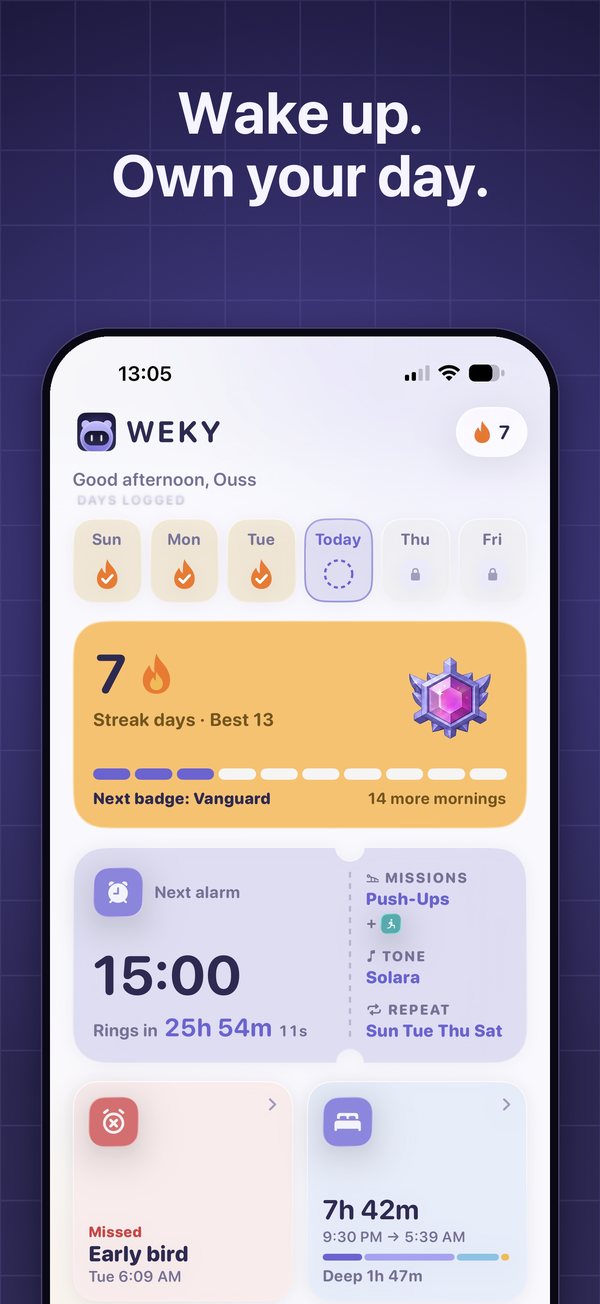
- Your bedtime, worked out for you. Set your wake-up alarm and Weky's Sleep tab shows Bedtime tonight, counted back from your next alarm using your sleep target.
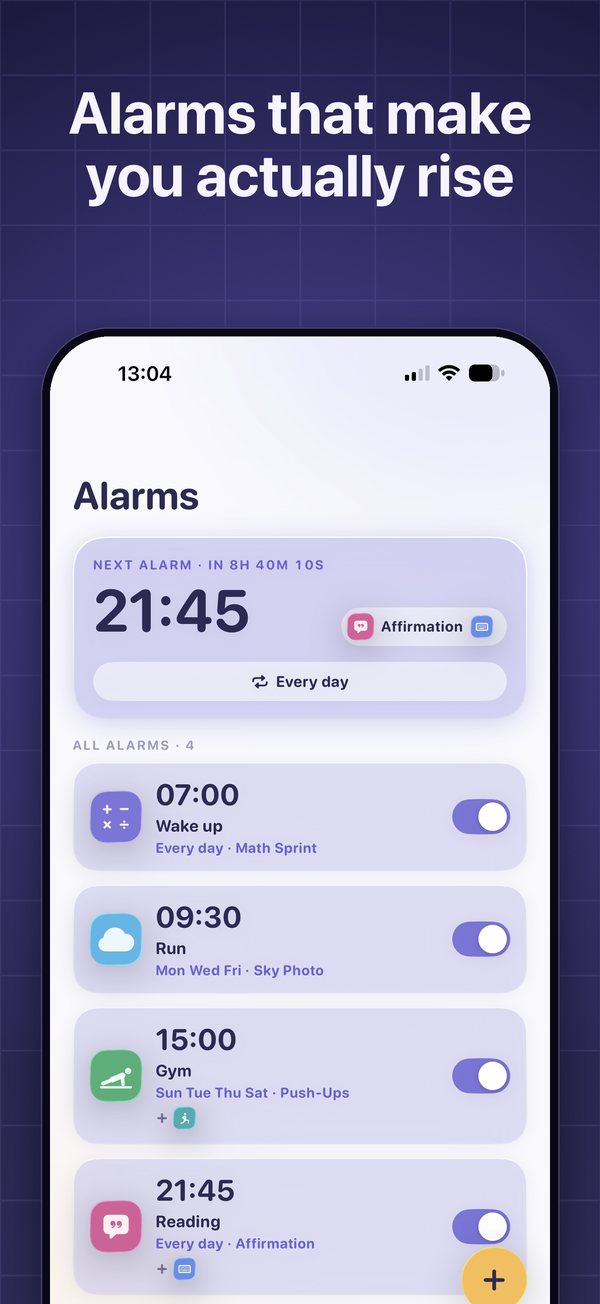
- The phone stops competing with bedtime. Block the apps you scroll in bed from a time you choose, say 30 minutes before bedtime. They stay locked until your morning mission is done.
- The wake time actually holds. Weky's alarm only stops after a wake-up mission, there's no snooze, and the wake-up check rings again a few minutes later. A fixed wake time is what makes your bedtime work.
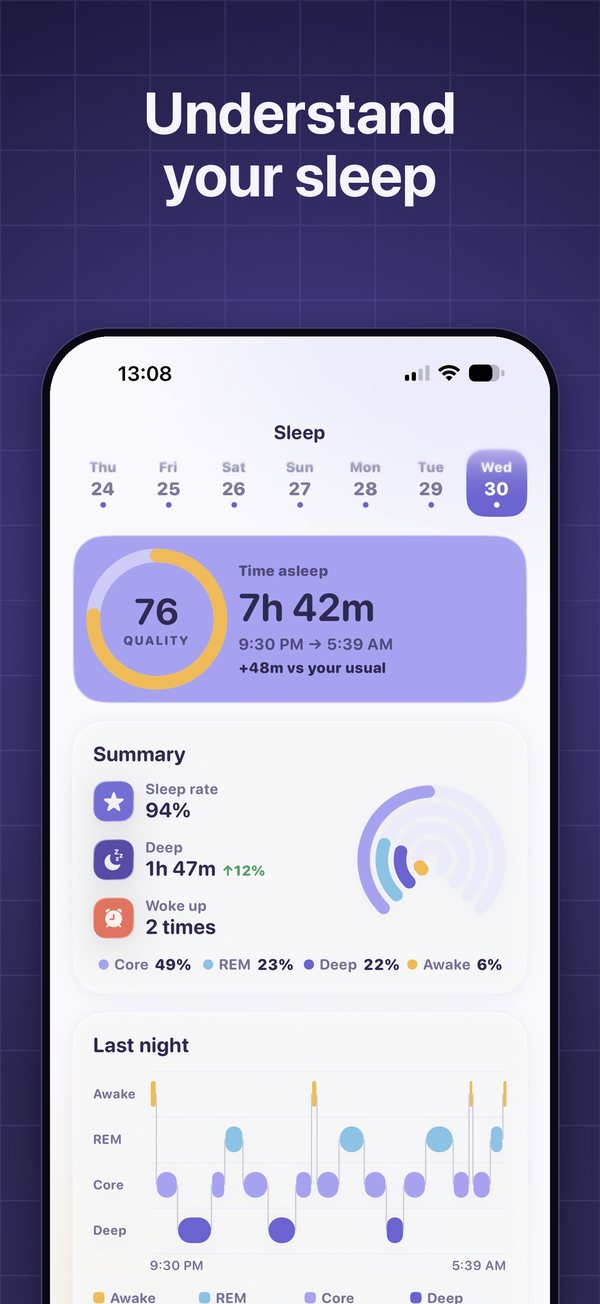
- You see what each night did to your morning. Weky reads your sleep from Apple Health and shows each night next to the morning that followed.
When to talk to a doctor
If you keep a regular bedtime and still take more than 30 minutes to fall asleep most nights, wake up repeatedly, snore loudly, or feel exhausted after a full night, talk to a doctor. Insomnia, sleep apnea and other sleep disorders are common and treatable, and no bedtime calculator can fix them.
Frequently asked questions
What time should I go to bed if I wake up at 6 a.m.?
For 7.5 hours of sleep (five 90-minute cycles) plus about 15 minutes to fall asleep, go to bed around 10:15 p.m. For 9 hours (six cycles), around 8:45 p.m. For 6 hours (four cycles), 11:45 p.m., though that's less than most adults need.
What time should I go to bed if I wake up at 7 a.m.?
Around 11:15 p.m. for 7.5 hours of sleep, or 9:45 p.m. for 9 hours, counting about 15 minutes to fall asleep.
How do I calculate my bedtime?
Start from your wake-up time, subtract the sleep you need (7 to 9 hours for most adults, or 7.5 or 9 hours if you count in 90-minute cycles), then subtract the time it usually takes you to fall asleep, around 10 to 20 minutes.
Is it better to sleep in 90-minute cycles?
Ninety minutes is an average; real cycles run roughly 70 to 120 minutes and change through the night. Counting in cycles is a useful rule of thumb that can help you avoid waking from deep sleep, but getting enough total sleep matters more.
Is 10 p.m. a good bedtime?
It is if it gives you enough sleep before your wake-up time. With a 6 to 7 a.m. alarm, 10 to 11 p.m. gives most adults the 7 to 9 hours they need.
Does going to bed at the same time matter?
Yes. A large study found that sleep regularity predicted health risk even better than sleep duration. Keeping the same wake time every day, weekends included, is the easiest way to make your bedtime regular too.
References
- Watson NF, Badr MS, Belenky G, et al. Recommended amount of sleep for a healthy adult: a joint consensus statement of the American Academy of Sleep Medicine and Sleep Research Society. Journal of Clinical Sleep Medicine, 2015;11(6):591–592.
- Hirshkowitz M, Whiton K, Albert SM, et al. National Sleep Foundation's sleep time duration recommendations: methodology and results summary. Sleep Health, 2015;1(1):40–43.
- Windred DP, Burns AC, Lane JM, et al. Sleep regularity is a stronger predictor of mortality risk than sleep duration: a prospective cohort study. Sleep, 2024;47(1):zsad253.
- Hilditch CJ, McHill AW. Sleep inertia: current insights. Nature and Science of Sleep, 2019;11:155–165.