To wake up for Fajr every day, go to bed early enough to get 7–9 hours of sleep, keep your phone away from your bed, and use an alarm you can't switch off half-asleep: one that rings until you're out of bed, ideally in another room. Set it a few minutes before the adhan, update it as Fajr moves through the year, and add a second check so you don't fall back asleep before you pray.
Why waking up for Fajr is so hard
If you keep missing Fajr, you're not alone, and it isn't only about faith or discipline. Several things work against you at that hour:
- It falls at the deepest part of the night. In summer, and in countries far from the equator, Fajr can come at 3 or 4 a.m., when your body clock is at its lowest point and your brain most wants to stay asleep.
- Its time keeps moving. Fajr shifts by a minute or two a day, so a fixed routine that works in winter stops working by spring.
- Too little sleep. Late Isha, late dinners, family time and screens push bedtime later, but Fajr doesn't move with them.
- Sleep inertia. When an alarm wakes you from deep sleep, your brain stays groggy for several minutes. That's when people switch off an alarm and fall back asleep without even remembering it.
- Dark and cold. At that hour there's no daylight to help you wake up, and the bed is at its warmest.
The good news: almost all of these can be planned around. People who wake up for Fajr every day rarely rely on willpower alone. They have a sleep schedule and an alarm setup that do most of the work.
Plan your sleep around Fajr
Know your Fajr time, and how it moves
Check your local mosque's timetable or a trusted prayer-time source, because the time depends on your location and the calculation method used. Set your alarm a few minutes before the adhan, or before the iqama if you pray at the mosque, so you have time for wudu. Then update it regularly; once a week is enough for most of the year.
Count back from Fajr to find your bedtime
Most adults need 7 to 9 hours of sleep. Add about 15 minutes to fall asleep and count back from your alarm:
| Fajr alarm | Sleep by (7 h) | Sleep by (8 h) |
|---|---|---|
| 3:30 | 20:15 | 19:15 |
| 4:30 | 21:15 | 20:15 |
| 5:30 | 22:15 | 21:15 |
| 6:30 | 23:15 | 22:15 |
In winter this is easy. In summer, when Fajr is very early and Isha very late, a full night in one block may be impossible. That's when many people split their rest: a main sleep that ends at Fajr, plus a short nap during the day. The habit of going to bed soon after Isha also has deep roots in Islamic tradition: it is reported in Sahih al-Bukhari that the Prophet ﷺ disliked sleeping before Isha and talking after it.
Should you go back to sleep after Fajr?
That depends on you and your schedule. From a sleep point of view, what matters is total sleep and regularity. If you rest again, set a second alarm for the time you need to start your day, so a short rest doesn't turn into oversleeping.
How to wake up for Fajr: 10 tips
1. Make your intention before you sleep
Go to bed having decided you'll wake up for Fajr, and know exactly why. A clear intention made the night before is much stronger than a decision you try to make at 4 a.m. while half asleep.
2. Sleep earlier, not just set the alarm earlier
An alarm can't create sleep you didn't get. Move your bedtime 15–30 minutes earlier every few days until you reach the time in the table above.
3. Put the phone away after Isha
In a sleep lab study, people who read on a light-emitting screen before bed took longer to fall asleep, had a later body clock and were less alert the next morning than when they read a printed book. Charge your phone outside the bedroom or across the room.
4. Keep dinner light and caffeine early
A heavy late meal and tea or coffee in the evening make it harder to fall asleep early. Try to finish dinner two to three hours before bed and keep caffeine to the morning and early afternoon.
5. Prepare like the Sunnah: wudu, then sleep on your right side
It is reported in Sahih al-Bukhari that the Prophet ﷺ advised making wudu before going to bed and lying on the right side. Many people find this short routine calms them down and signals that the day is over.
6. Put the alarm where you have to get up
If you can reach the alarm from bed, you can switch it off half-asleep. Put the phone across the room, or use an alarm that only stops when you've done something that gets you out of bed.
7. Turn on the light immediately
Light tells your brain it's time to be awake. Switch on the light as soon as you're up, before you make wudu.
8. Let wudu wake you up
Cool water on your face, hands and feet is one of the fastest ways through the groggy first minutes. Go straight to the sink: by the time you've finished wudu, the hardest part is behind you.
9. Ask someone to help
A family member, a roommate or a friend who goes to the mosque can wake you or call you. Many people find it much easier to wake up when someone is counting on them.
10. Take a short nap during the day
If your nights are short, a nap of about 10–20 minutes in the early afternoon can restore alertness without leaving you groggy. In a study of people after a short night, a 10-minute nap gave the best balance of alertness and little grogginess; longer naps made people groggier afterwards.
An alarm you can't switch off half-asleep: how Weky helps
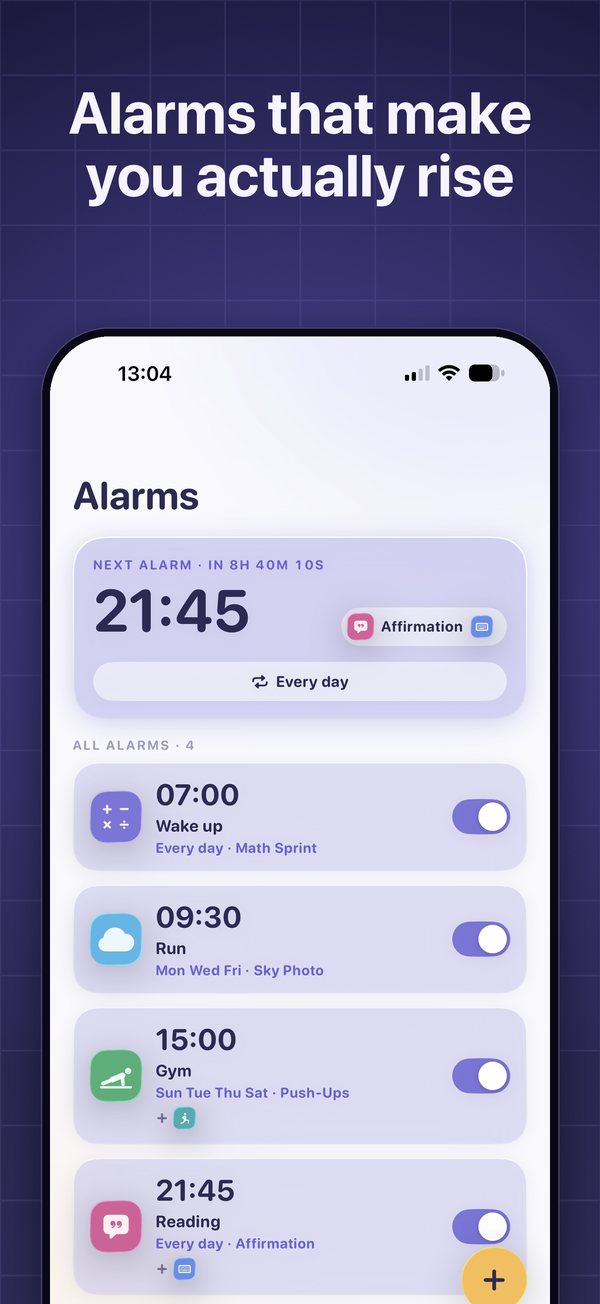
Most missed Fajr prayers have the same story: the alarm rang, and a half-asleep hand switched it off. Weky is an iPhone alarm built for exactly that moment. It only stops when you complete a wake-up mission, so you're awake and out of bed before it goes quiet.
- A mission that takes you to wudu. Choose a barcode mission and scan a product you keep by the sink, like your soap or toothpaste. The alarm keeps ringing until you've walked there, which is exactly where you need to be. You can also use push-ups, a few math problems or other missions, up to five per alarm.
- No snooze, and a second check. Weky has no snooze button. Turn on the wake-up check and Weky asks you again 5 to 30 minutes later (10 by default), so you can't finish the mission and slip back under the blanket before praying.
- No switching it off at midnight. Before it rings, the alarm locks, so you can't cancel it late at night on a whim. In Settings, Guard Weky while ringing stops you from deleting the app to get back to sleep.
- Rings in Silent mode and Focus. Weky schedules a real system alarm, so it rings even with Silent mode or Sleep Focus on.
- Phone locked until you're up. With App blocking, the apps you scroll in bed stay locked from the time you choose, for example after Isha, until your morning mission is done.
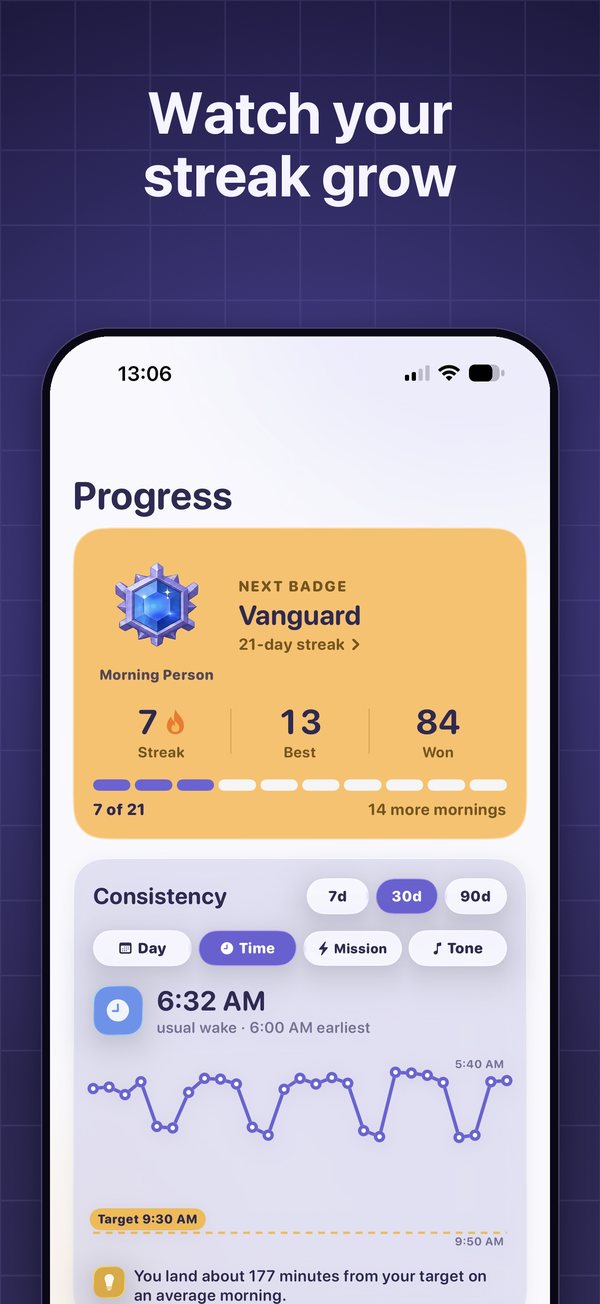
- Your bedtime and your streak. The Sleep tab shows Bedtime tonight, counted back from your next alarm. Switch on Track as a habit, choose Custom and call it Fajr, and every morning you wake up builds your streak on its own 90-day calendar.
One thing to know: Weky doesn't calculate prayer times. You set the alarm time yourself, so update it as Fajr moves, for example every weekend.

A simple plan for this week
- Tonight: Check tomorrow's Fajr time, set your alarm a few minutes before it, and put the phone across the room.
- Days 2–3: Move bedtime 15–30 minutes earlier. Make wudu before bed.
- Days 4–5: Add a mission outside the bedroom and turn on the wake-up check.
- Days 6–7: Keep the same routine. If the nights are short, add a 10–20 minute nap after Dhuhr.
Like any habit, the first week is the hardest. After a few weeks of the same bedtime and the same alarm, waking up for Fajr starts to feel natural, and your body begins to wake up just before the alarm.
Weky is free to download; Weky Pro is available monthly, yearly (with a 7-day free trial) or lifetime.
If you often sleep through alarms, read why you sleep through your alarm and the best alarm app for heavy sleepers. To move your whole schedule earlier, see how to wake up early.
Frequently asked questions
How can I wake up for Fajr if I'm a heavy sleeper?
Use an alarm you can't switch off half-asleep: one that only stops after a task that gets you out of bed, placed or set so you have to walk to another room. Add a second check a few minutes later, go to bed earlier, and keep your phone away from the bed.
What time should I sleep to wake up for Fajr?
Count back 7 to 9 hours from the time you need to wake up, plus 15 minutes to fall asleep. If Fajr is at 5:00 and you want to be up at 4:50, aim to be asleep between about 20:50 (8 hours) and 21:50 (7 hours). When nights are short in summer, combine an earlier bedtime with a short daytime nap.
Why can't I wake up for Fajr even with an alarm?
Usually because of too little sleep, late screens, and waking from deep sleep, which makes your brain groggy enough to switch off an alarm without remembering. A regular schedule, an earlier bedtime and an alarm that requires you to get up solve most cases.
Should I go back to sleep after Fajr?
That's a personal choice. From a sleep point of view, what matters is getting enough total sleep and keeping your schedule regular. If you rest again, keep it short and set a second alarm so you don't oversleep.
Does Fajr time change every day?
Yes. It moves by about a minute or two per day, more in spring and autumn and at higher latitudes, and it depends on the calculation method your local mosque uses. Check your local timetable and update your alarm regularly, for example once a week.
Is a short nap during the day helpful if I wake up for Fajr?
Yes. A short daytime nap of about 10–20 minutes can restore alertness after a short night without leaving you groggy. Longer naps are more likely to cause grogginess and can make it harder to fall asleep early at night.
References
- Hirshkowitz M, Whiton K, Albert SM, et al. National Sleep Foundation's sleep time duration recommendations: methodology and results summary. Sleep Health, 2015;1(1):40–43.
- Hilditch CJ, McHill AW. Sleep inertia: current insights. Nature and Science of Sleep, 2019;11:155–165.
- Chang AM, Aeschbach D, Duffy JF, Czeisler CA. Evening use of light-emitting eReaders negatively affects sleep, circadian timing, and next-morning alertness. Proceedings of the National Academy of Sciences, 2015;112(4):1232–1237.
- Brooks A, Lack L. A brief afternoon nap following nocturnal sleep restriction: which nap duration is most recuperative? Sleep, 2006;29(6):831–840.