
It takes about 66 days on average to form a habit, not 21. In the best-known study, the time for a new daily behaviour to become automatic ranged from 18 to 254 days, depending on the person and how hard the habit was. Simple habits tied to a clear cue form in a few weeks; exercise and complex routines can take months.
That's good news, not bad. If you gave up on a habit around day 22 because it still felt like effort, nothing was wrong with you. You were simply early. Below: where the 21-day idea came from, what the research actually shows, and how to make a habit stick sooner.
Key takeaways
- Average: 66 days. Range: 18 to 254 days. Plan for two to three months, not three weeks.
- The 21-day rule is a myth from a 1960 self-help book, not a study.
- Simple, cue-based habits form fastest; exercise and effortful routines take longest.
- Missing one day doesn't ruin it. Just don't miss twice in a row.
- Same time, same cue, every day is the single biggest accelerator.
Where the 21-day myth comes from
In 1960, plastic surgeon Maxwell Maltz wrote in his bestseller Psycho-Cybernetics that patients seemed to take "a minimum of about 21 days" to get used to a change, like a new face or a lost limb. Over the decades, "a minimum of about 21 days" became "21 days", and "getting used to a change" became "forming a habit". It was an observation about adjusting, never a measurement of habit formation.
The rule stuck because it's tidy and motivating: three weeks feels doable. The trouble is that it sets people up to quit right when the habit is still fragile.
What the research actually says
In a study at University College London, 96 people chose one new daily habit: eating a piece of fruit with lunch, drinking a bottle of water, running before dinner. Each day they rated how automatic it felt. On average, it took 66 days for the behaviour to reach its peak automaticity. But the spread was huge: 18 days for the fastest, and for some, the curve suggested it would take 254 days.
Two more findings matter just as much:
- Harder habits took longer. Drinking water became automatic faster than doing exercise.
- Missing one day didn't matter much. A single missed opportunity didn't materially change how the habit formed.
A larger 2023 study used data from tens of thousands of gym-goers and hospital workers. Gym habits typically took months to form, while handwashing at work formed in weeks. The same study found consistency mattered: people who exercised at the same time and on the same days built the habit more reliably.

Why some habits take longer than others
| What speeds it up | What slows it down |
|---|---|
| A small, simple action | A big or effortful action |
| The same time every day | A different time each day |
| A clear cue that already happens (waking up, coffee) | "Whenever I find time" |
| An immediate reward or feeling of progress | Benefits only weeks later |
| An easy start (shoes by the door) | Friction before the first step |
A habit is a link between a cue and an action, stored through repetition. The more stable the cue and the easier the action, the faster that link forms. That's why "drink water after brushing my teeth" becomes automatic long before "go to the gym three times a week".
How to make a habit stick faster: 7 tactics
- Pick one fixed time. Same time, every day. Morning habits often win, because your wake-up is the most reliable cue of the day.
- Anchor it to something you already do. "After I wake up, I do ten push-ups." "After my coffee, I read for ten minutes." This is often called habit stacking.
- Write an if-then plan. "If it's 7:00, then I put on my running shoes." A meta-analysis of 94 studies found these implementation intentions clearly improve follow-through.
- Start smaller than feels useful. Two minutes of reading, five squats, one page. You're building the cue-action link first; size comes later.
- Remove friction. Lay out the book, the shoes, the water glass the night before. Make the first step almost automatic.
- Track it visibly. A calendar of done days turns invisible progress into something you can see, and that is motivating in itself.
- Never miss twice. One missed day is noise. Two in a row is the start of a new habit: not doing it.
Does missing a day reset your habit?
No. The research is clear that one miss barely affects habit formation. What breaks habits is a slide: one day becomes three, and the cue stops triggering the action. So treat a missed day as information, not failure. Restart at the very next opportunity, at the same time, with the same cue. If you missed because the habit was too big, shrink it.
How Weky helps you build a habit that sticks
Everything above comes down to three things: a fixed cue at a fixed time, a clear "done", and a visible record. That's exactly how habits work in Weky.
- Every habit gets its own alarm. Switch on Track as a habit in the alarm editor and choose gym, running, reading, study, meditation or your own. The alarm becomes the fixed daily cue, at the same time every day.
- A mission marks it done. The day only counts when the alarm's mission is completed: push-ups before the gym, scanning the barcode of something in your gym bag, a typing challenge before study. No ticking a box from bed.
- A 90-day calendar for each habit. In the habit tracker, each habit shows the last 90 days as done, late or missed, so one miss never erases the weeks you've built.
- A streak to protect. Each habit has its own streak, separate from your wake-up streak, so a skipped gym day doesn't break your mornings.
- The morning as your anchor. After your wake-up mission, Start My Day offers a short checklist of small morning habits to tick or skip, stacked on the one cue that happens every day.
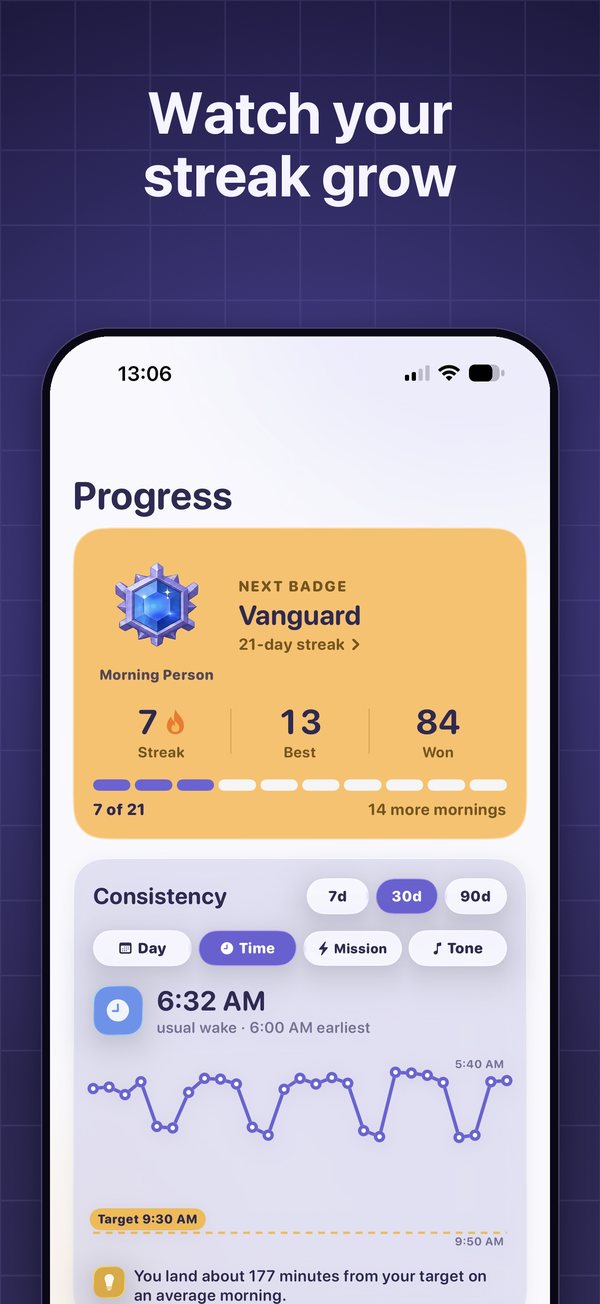


Plan for about two months, not three weeks. If your new habit still feels like effort on day 30, you're on schedule. Keep the cue fixed, keep the action small, and let the calendar fill up.
Frequently asked questions
How long does it take to form a habit?
In the best-known study, it took 66 days on average for a new daily behaviour to become automatic, with a range from 18 to 254 days depending on the person and the habit. Simple habits form faster; exercise and complex routines take longer.
Is it true that it takes 21 days to form a habit?
No. The 21-day figure comes from a 1960 self-help book by surgeon Maxwell Maltz, who wrote that people take a minimum of about 21 days to adjust to a change. It was never a research finding about habits, and later studies found much longer averages.
What is the 21/90 rule?
A popular rule of thumb: 21 days to build a habit and 90 days to make it a lifestyle. It isn't based on research, but the 90-day part is closer to reality than the 21: most habits need two to three months of repetition.
Does missing one day ruin a habit?
No. In the study that found the 66-day average, missing a single opportunity did not materially affect how the habit formed. What matters is getting back on track the next day: try never to miss twice in a row.
What habits take the longest to form?
Habits that need more effort or happen less predictably, such as exercise, take the longest; one large study of gym-goers found habits forming over months. Simple habits tied to a clear cue, like drinking a glass of water after breakfast, form much faster.
How can I make a habit stick faster?
Do it at the same time and place every day, tie it to an existing cue, start very small, plan it with an if-then statement, make it easy to start, and track it so you can see your progress.
References
- Lally P, van Jaarsveld CHM, Potts HWW, Wardle J. How are habits formed: modelling habit formation in the real world. European Journal of Social Psychology, 2010;40(6):998–1009.
- Buyalskaya A, Ho H, Milkman KL, Li X, Duckworth AL, Camerer C. What can machine learning teach us about habit formation? Evidence from exercise and hygiene. Proceedings of the National Academy of Sciences, 2023;120(17):e2216115120.
- Gollwitzer PM, Sheeran P. Implementation intentions and goal achievement: a meta-analysis of effects and processes. Advances in Experimental Social Psychology, 2006;38:69–119.
- Wood W, Neal DT. A new look at habits and the habit-goal interface. Psychological Review, 2007;114(4):843–863.
- Maltz M. Psycho-Cybernetics. Prentice-Hall, 1960.